
README.md 8.1 KB
OpenCode Agents
A set of OpenCode configurations, prompts, agents, and plugins for enhanced development workflows.
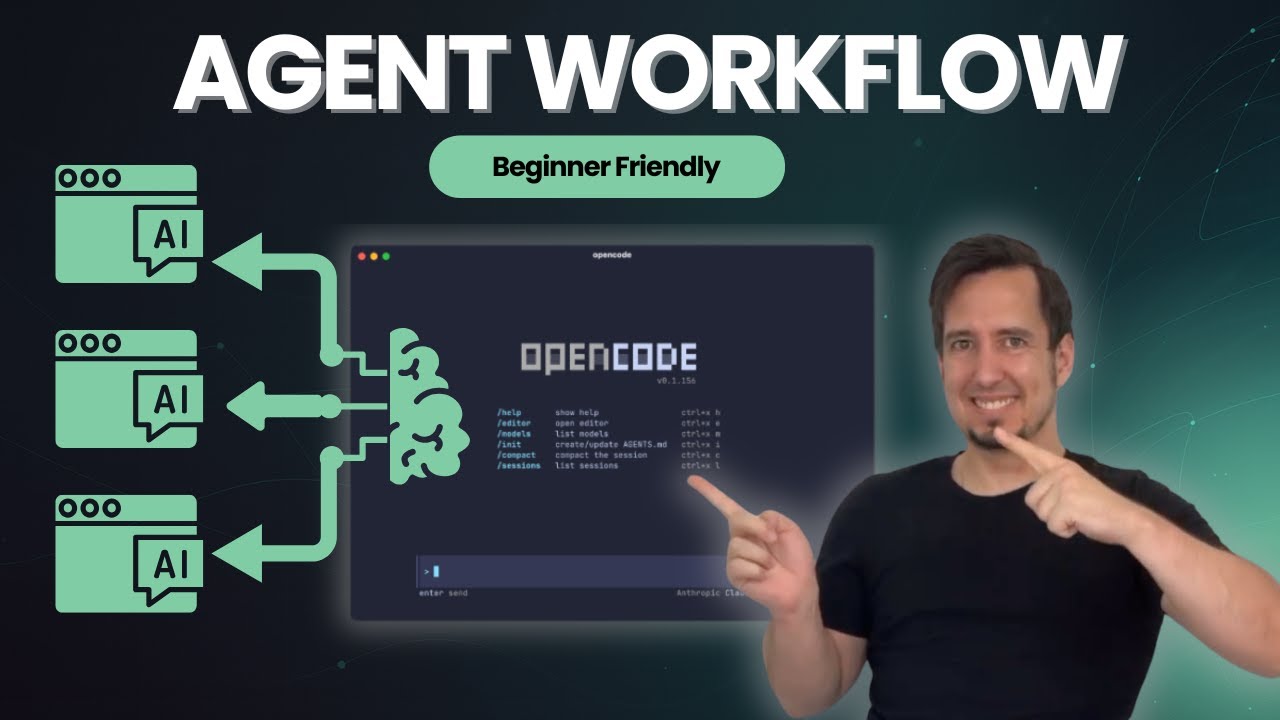
Why Use This?
- ✅ Multi-language support - Works with TypeScript, Python, Go, Rust, and more
- ✅ Plan-first workflow - Agents propose plans before implementing
- ✅ Incremental execution - Step-by-step implementation with validation
- ✅ Quality built-in - Automatic testing, type checking, and code review
- ✅ Your patterns - Agents follow your coding standards from context files
Quick Start
Step 1: Install OpenCode CLI
# Follow official guide
https://opencode.ai/docs
Step 2: Install Agents & Commands
# Clone this repository
git clone https://github.com/darrenhinde/opencode-agents.git
cd opencode-agents

# Install to OpenCode directory (global)
mkdir -p ~/.opencode
cp -r .opencode/agent ~/.opencode/
cp -r .opencode/command ~/.opencode/
cp -r .opencode/context ~/.opencode/
Step 3: Start Building
# Start the main development agent (recommended for new users)
opencode --agent codebase-agent

# Tell it what to build
> "Create a React todo list with TypeScript"
What happens next:
- Agent proposes an implementation plan
- Asks for your approval
- Implements step-by-step with validation
- Delegates to @task-manager for complex features
- Uses @tester and @reviewer for quality assurance
How It Works
User Request
    ↓
codebase-agent (main coordinator)
    ↓
    ├─→ @task-manager (breaks down complex features)
    ├─→ @tester (writes and runs tests)
    ├─→ @reviewer (security and code review)
    ├─→ @documentation (generates docs)
    └─→ @build-agent (type checking and validation)
The workflow:
- You describe what you want to build
- Agent plans the implementation steps
- You approve the plan
- Agent implements incrementally with validation
- Quality checks run automatically (tests, types, linting)
- Subagents handle specialized tasks (testing, review, docs)
Context-aware: Agents automatically load patterns from .opencode/context/ to follow your coding standards.
What's Included
🤖 Main Agents
- codebase-agent - Your main development partner (recommended for most tasks)
- task-manager - Breaks complex features into manageable subtasks
- workflow-orchestrator - Routes requests to appropriate workflows
- image-specialist - Generates images with Gemini AI
🔧 Specialized Subagents (Auto-delegated)
- reviewer - Code review and security analysis
- tester - Test creation and validation
- coder-agent - Quick implementation tasks
- documentation - Documentation generation
- build-agent - Build and type checking
- codebase-pattern-analyst - Pattern discovery
⚡ Commands
- /commit - Smart git commits with conventional format
- /optimize - Code optimization
- /test - Testing workflows
- /clean - Cleanup operations
- /context - Context management
- /prompt-enchancer - Improve your prompts
- /worktrees - Git worktree management
📚 Context Files
core/essential-patterns.md- Universal coding patternsproject/project-context.md- Your project-specific patterns
Example Workflows
Build a Feature
opencode --agent codebase-agent
> "Create a user authentication system with email/password"

# Agent will:
# 1. Propose implementation plan
# 2. Wait for your approval
# 3. Delegate to @task-manager (creates tasks/subtasks/user-auth/)
# 4. Implement step-by-step
# 5. Use @tester for tests
# 6. Use @reviewer for security review
Make a Commit
# Make your changes
git add .

# Use the commit command
/commit

# Auto-generates: ✨ feat: add user authentication system
Add Your Patterns
# Edit your project context
nano ~/.opencode/context/project/project-context.md

# Add your patterns:
# **API Endpoint Pattern:**
# ```typescript
# export async function POST(request: Request) {
#   // Your standard pattern
# }
# ```

# Agents will automatically use these patterns!
Optional Add-ons
📱 Telegram Notifications
Get notified when OpenCode sessions go idle.
# Copy plugin directory
cp -r .opencode/plugin ~/.opencode/

# Install dependencies
cd ~/.opencode/plugin
npm install

# Configure
cd ~/opencode-agents
cp env.example .env
# Edit .env with TELEGRAM_BOT_TOKEN and TELEGRAM_CHAT_ID
Get credentials: Message @BotFather on Telegram → /newbot → Save token
See .opencode/plugin/README.md for detailed documentation.
🎨 Gemini AI Image Tools
Generate and edit images using Gemini AI.
# Copy tool directory
cp -r .opencode/tool ~/.opencode/

# Install dependencies
cd ~/.opencode/tool
npm install

# Configure
cd ~/opencode-agents
cp env.example .env
# Edit .env with GEMINI_API_KEY
Get API key: https://makersuite.google.com/app/apikey
Common Questions
Q: What's the main way to use this?
A: Use opencode --agent codebase-agent for development. It coordinates everything else.
Q: Do I need to install plugins/tools?
A: No, they're optional. Only install if you want Telegram notifications or Gemini AI features.
Q: Where should I install - globally or per-project?
A: Global (~/.opencode/) works for most. Project-specific (.opencode/) if you need different configs per project.
Q: How do I add my own coding patterns?
A: Edit ~/.opencode/context/project/project-context.md - agents automatically load this file.
Q: What languages are supported?
A: The agents work with any language (TypeScript, Python, Go, Rust, etc.) and adapt based on your project files.
Q: What's the AGENT-SYSTEM-BLUEPRINT.md for?
A: It's a teaching document explaining architecture patterns and how to extend the system.
Q: Can I use just one command or agent?
A: Yes! Cherry-pick individual files with curl:
curl -o ~/.opencode/agent/codebase-agent.md \
  https://raw.githubusercontent.com/darrenhinde/opencode-agents/main/.opencode/agent/codebase-agent.md
Advanced
Understanding the System
Read AGENT-SYSTEM-BLUEPRINT.md to learn:
- How context loading works (the
@symbol) - Agent architecture patterns
- How to create custom agents and commands
- How to extend the system for your needs
Safety & Security
- Approval-first workflow - Agents propose plans before execution
- Configurable permissions - Granular control over agent capabilities
- Secure credentials - Environment variables for sensitive data
- Input sanitization - Protection against injection attacks
Project Structure
.opencode/
├── agent/              # AI agents
│   ├── codebase-agent.md
│   ├── task-manager.md
│   └── subagents/      # Specialized helpers
├── command/            # Slash commands
│   ├── commit.md
│   └── optimize.md
├── context/            # Coding patterns
│   ├── core/           # Essential patterns
│   └── project/        # Your patterns
├── plugin/             # Optional: Telegram
└── tool/               # Optional: Gemini AI
Contributing
- Follow the established naming conventions and coding standards
- Write comprehensive tests for new features
- Update documentation for any changes
- Ensure security best practices are followed
License
This project is licensed under the MIT License.
Recommended for New Users
Start with codebase-agent - it's your main development partner that handles planning, implementation, and quality assurance. It automatically delegates to specialized subagents when needed, so you don't have to manage multiple agents yourself.
opencode --agent codebase-agent
> "Your development task here"
The agent will guide you through the entire development workflow with a plan-first, approval-based approach.