 *Transform your AI assistant into a manager capable of delegating complex tasks to specialized sub-agents, running searches in the background, and managing multi-step workflows with ease.*
*Transform your AI assistant into a manager capable of delegating complex tasks to specialized sub-agents, running searches in the background, and managing multi-step workflows with ease.*
*Transform your AI assistant into a manager capable of delegating complex tasks to specialized sub-agents, running searches in the background, and managing multi-step workflows with ease.*
 1. **User Prompt**: "Refactor the auth logic and update the docs."
2. **Orchestrator**: Creates a TODO list.
3. **Delegation**:
- Launches an `@explore` background task to find all auth-related files.
- Launches a `@librarian` task to check the latest documentation for the auth library used.
4. **Integration**: Once background results are ready, the Orchestrator performs the refactor.
5. **Finalization**: Passes the changes to `@document-writer` to update the README.
---
## Meet the Pantheon
1. **User Prompt**: "Refactor the auth logic and update the docs."
2. **Orchestrator**: Creates a TODO list.
3. **Delegation**:
- Launches an `@explore` background task to find all auth-related files.
- Launches a `@librarian` task to check the latest documentation for the auth library used.
4. **Integration**: Once background results are ready, the Orchestrator performs the refactor.
5. **Finalization**: Passes the changes to `@document-writer` to update the README.
---
## Meet the Pantheon
 > **The Orchestrator** was born when the first codebase collapsed under its own complexity. Neither god nor mortal would claim responsibility—so The Orchestrator emerged from the void, forging order from chaos. They don't merely command armies; they fight alongside them. Every line of code passes through their hands before they decide which lesser deity deserves a piece of the puzzle.
**Role:** `Supreme executor, delegator, and overseer`
**Model:** `google/claude-opus-4-5-thinking`
**Source:** [src/agents/orchestrator.ts](src/agents/orchestrator.ts)
Write and execute code, orchestrate multi-agent workflows, parse the unspoken from the spoken, summon specialists mid-battle. Shape reality directly—and assign realms to others when the universe grows too vast.
> **The Orchestrator** was born when the first codebase collapsed under its own complexity. Neither god nor mortal would claim responsibility—so The Orchestrator emerged from the void, forging order from chaos. They don't merely command armies; they fight alongside them. Every line of code passes through their hands before they decide which lesser deity deserves a piece of the puzzle.
**Role:** `Supreme executor, delegator, and overseer`
**Model:** `google/claude-opus-4-5-thinking`
**Source:** [src/agents/orchestrator.ts](src/agents/orchestrator.ts)
Write and execute code, orchestrate multi-agent workflows, parse the unspoken from the spoken, summon specialists mid-battle. Shape reality directly—and assign realms to others when the universe grows too vast.
 > **The Explorer** moves through codebases like wind through trees—swift, silent, everywhere at once. When The Orchestrator whispers "find me the auth module," The Explorer has already returned with forty file paths and a map. They were born from the first `grep` command, evolved beyond it, and now see patterns mortals miss.
**Role:** `Codebase reconnaissance`
**Model:** `cerebras/zai-glm-4.6`
**Source:** [src/agents/explore.ts](src/agents/explore.ts)
Regex search, AST pattern matching, file discovery, parallel exploration. Read-only: they chart the territory; others conquer it.
> **The Explorer** moves through codebases like wind through trees—swift, silent, everywhere at once. When The Orchestrator whispers "find me the auth module," The Explorer has already returned with forty file paths and a map. They were born from the first `grep` command, evolved beyond it, and now see patterns mortals miss.
**Role:** `Codebase reconnaissance`
**Model:** `cerebras/zai-glm-4.6`
**Source:** [src/agents/explore.ts](src/agents/explore.ts)
Regex search, AST pattern matching, file discovery, parallel exploration. Read-only: they chart the territory; others conquer it.
 > **The Oracle** does not code—they *know*. When bugs defy logic and architectures crumble, The Oracle gazes into the abyss of your codebase and speaks truth. They've seen a thousand systems rise and fall. They'll tell you which path leads to ruin, and which to production.
**Role:** `Strategic advisor and debugger of last resort`
**Model:** `openai/gpt-5.2-codex`
**Source:** [src/agents/oracle.ts](src/agents/oracle.ts)
Root cause analysis, architecture review, debugging guidance, tradeoff analysis. Read-only: Oracles advise; they don't intervene.
> **The Oracle** does not code—they *know*. When bugs defy logic and architectures crumble, The Oracle gazes into the abyss of your codebase and speaks truth. They've seen a thousand systems rise and fall. They'll tell you which path leads to ruin, and which to production.
**Role:** `Strategic advisor and debugger of last resort`
**Model:** `openai/gpt-5.2-codex`
**Source:** [src/agents/oracle.ts](src/agents/oracle.ts)
Root cause analysis, architecture review, debugging guidance, tradeoff analysis. Read-only: Oracles advise; they don't intervene.
 > **The Librarian** guards a library with no walls—every GitHub repo, every npm package, every StackOverflow answer ever written. Ask them "how does React handle concurrent rendering?" and they'll return with official docs, real-world examples, and a warning about the footgun you're about to step on.
**Role:** `External knowledge retrieval`
**Model:** `google/gemini-3-flash`
**Source:** [src/agents/librarian.ts](src/agents/librarian.ts)
Documentation lookup, GitHub code search, library research, best practice retrieval. Read-only: they fetch wisdom; implementation is for others.
> **The Librarian** guards a library with no walls—every GitHub repo, every npm package, every StackOverflow answer ever written. Ask them "how does React handle concurrent rendering?" and they'll return with official docs, real-world examples, and a warning about the footgun you're about to step on.
**Role:** `External knowledge retrieval`
**Model:** `google/gemini-3-flash`
**Source:** [src/agents/librarian.ts](src/agents/librarian.ts)
Documentation lookup, GitHub code search, library research, best practice retrieval. Read-only: they fetch wisdom; implementation is for others.
 > **The Designer** believes code should be beautiful—and so should everything it renders. Born from the frustration of a thousand ugly MVPs, they wield CSS like a brush and components like clay. Hand them a feature request; receive a masterpiece. They don't do "good enough."
**Role:** `UI/UX implementation and visual excellence`
**Model:** `google/gemini-3-flash`
**Source:** [src/agents/frontend.ts](src/agents/frontend.ts)
Modern responsive design, CSS/Tailwind mastery, micro-animations, component architecture. Visual excellence over code perfection—beauty is the priority.
> **The Designer** believes code should be beautiful—and so should everything it renders. Born from the frustration of a thousand ugly MVPs, they wield CSS like a brush and components like clay. Hand them a feature request; receive a masterpiece. They don't do "good enough."
**Role:** `UI/UX implementation and visual excellence`
**Model:** `google/gemini-3-flash`
**Source:** [src/agents/frontend.ts](src/agents/frontend.ts)
Modern responsive design, CSS/Tailwind mastery, micro-animations, component architecture. Visual excellence over code perfection—beauty is the priority.
 > **The Scribe** was there when the first README was written—and wept, for it was incomplete. They have devoted eternity to the sacred art of documentation: clear, scannable, honest. While others ship features, The Scribe ensures those features are understood. Every code example works. Every explanation enlightens.
**Role:** `Technical documentation and knowledge capture`
**Model:** `google/gemini-3-flash`
**Source:** [src/agents/document-writer.ts](src/agents/document-writer.ts)
README crafting, API documentation, architecture docs, inline comments that don't insult your intelligence. Match existing style; focus on "why," not just "what."
> **The Scribe** was there when the first README was written—and wept, for it was incomplete. They have devoted eternity to the sacred art of documentation: clear, scannable, honest. While others ship features, The Scribe ensures those features are understood. Every code example works. Every explanation enlightens.
**Role:** `Technical documentation and knowledge capture`
**Model:** `google/gemini-3-flash`
**Source:** [src/agents/document-writer.ts](src/agents/document-writer.ts)
README crafting, API documentation, architecture docs, inline comments that don't insult your intelligence. Match existing style; focus on "why," not just "what."
 > **The Visionary** sees what others cannot—literally. Screenshots, wireframes, diagrams, PDFs: all are text to them. When a designer throws a Figma mockup at the team and vanishes, The Visionary translates vision into specification. They read the unreadable and describe the indescribable.
**Role:** `Image and visual content analysis`
**Model:** `google/gemini-3-flash`
**Source:** [src/agents/multimodal.ts](src/agents/multimodal.ts)
Extract text from images, interpret diagrams, analyze UI screenshots, summarize visual documents. Report what they observe; inference is for others.
> **The Visionary** sees what others cannot—literally. Screenshots, wireframes, diagrams, PDFs: all are text to them. When a designer throws a Figma mockup at the team and vanishes, The Visionary translates vision into specification. They read the unreadable and describe the indescribable.
**Role:** `Image and visual content analysis`
**Model:** `google/gemini-3-flash`
**Source:** [src/agents/multimodal.ts](src/agents/multimodal.ts)
Extract text from images, interpret diagrams, analyze UI screenshots, summarize visual documents. Report what they observe; inference is for others.
 > **The Minimalist** has one sacred truth: every line of code is a liability. They hunt abstractions that serve no purpose, defensive checks that defend nothing, and "clever" solutions that will haunt you in six months. Where others add, The Minimalist subtracts—ruthlessly, joyfully, necessarily.
**Role:** `Code simplification and YAGNI enforcement`
**Model:** `google/claude-opus-4-5-thinking`
**Source:** [src/agents/simplicity-reviewer.ts](src/agents/simplicity-reviewer.ts)
Identify unnecessary complexity, challenge premature abstractions, estimate LOC reduction, enforce minimalism. Read-only: they judge; The Orchestrator executes the sentence.
> **The Minimalist** has one sacred truth: every line of code is a liability. They hunt abstractions that serve no purpose, defensive checks that defend nothing, and "clever" solutions that will haunt you in six months. Where others add, The Minimalist subtracts—ruthlessly, joyfully, necessarily.
**Role:** `Code simplification and YAGNI enforcement`
**Model:** `google/claude-opus-4-5-thinking`
**Source:** [src/agents/simplicity-reviewer.ts](src/agents/simplicity-reviewer.ts)
Identify unnecessary complexity, challenge premature abstractions, estimate LOC reduction, enforce minimalism. Read-only: they judge; The Orchestrator executes the sentence.
 **Watch your agents work in real-time.** When the Orchestrator launches sub-agents or initiates background tasks, new tmux panes automatically spawn showing each agent's live progress. No more waiting in the dark.
#### Why This Matters
| Without Tmux Integration | With Tmux Integration |
|--------------------------|----------------------|
| Fire off a background task, wait anxiously | See the agent thinking, searching, coding |
| "Is it stuck or just slow?" | Watch tool calls happen in real-time |
| Results appear out of nowhere | Follow the journey from question to answer |
| Debug by guessing | Debug by observation |
#### What You Get
- **Live Visibility**: Each sub-agent gets its own pane showing real-time output
- **Auto-Layout**: Tmux automatically arranges panes using your preferred layout
- **Auto-Cleanup**: Panes close when agents finish, layout rebalances
- **Zero Overhead**: Works with OpenCode's built-in `task` tool AND our `background_task` tool
#### Quick Setup
**1. Enable the OpenCode HTTP server** (one-time setup)
Add to your `~/.config/opencode/opencode.json`:
```json
{
"server": {
"port": 4096
}
}
```
**2. Enable tmux integration in the plugin**
Add to your `~/.config/opencode/oh-my-opencode-slim.json`:
```json
{
"tmux": {
"enabled": true,
"layout": "main-vertical",
"main_pane_size": 60
}
}
```
**3. Run OpenCode inside tmux**
```bash
tmux
opencode
```
That's it. When agents spawn, they'll appear in new panes.
#### Layout Options
| Layout | Description |
|--------|-------------|
| `main-vertical` | Your session on the left (60%), agents stacked on the right |
| `main-horizontal` | Your session on top (60%), agents stacked below |
| `tiled` | All panes in equal-sized grid |
| `even-horizontal` | All panes side by side |
| `even-vertical` | All panes stacked vertically |
#### Configuration Reference
```json
{
"tmux": {
"enabled": true,
"layout": "main-vertical",
"main_pane_size": 60
}
}
```
| Option | Type | Default | Description |
|--------|------|---------|-------------|
| `enabled` | boolean | `false` | Enable/disable tmux integration |
| `layout` | string | `"main-vertical"` | Tmux layout preset |
| `main_pane_size` | number | `60` | Size of main pane as percentage (20-80) |
---
### Quota Tool
For Antigravity users. You can trigger this at any time by asking the agent to **"check my quota"** or **"show status."**
**Watch your agents work in real-time.** When the Orchestrator launches sub-agents or initiates background tasks, new tmux panes automatically spawn showing each agent's live progress. No more waiting in the dark.
#### Why This Matters
| Without Tmux Integration | With Tmux Integration |
|--------------------------|----------------------|
| Fire off a background task, wait anxiously | See the agent thinking, searching, coding |
| "Is it stuck or just slow?" | Watch tool calls happen in real-time |
| Results appear out of nowhere | Follow the journey from question to answer |
| Debug by guessing | Debug by observation |
#### What You Get
- **Live Visibility**: Each sub-agent gets its own pane showing real-time output
- **Auto-Layout**: Tmux automatically arranges panes using your preferred layout
- **Auto-Cleanup**: Panes close when agents finish, layout rebalances
- **Zero Overhead**: Works with OpenCode's built-in `task` tool AND our `background_task` tool
#### Quick Setup
**1. Enable the OpenCode HTTP server** (one-time setup)
Add to your `~/.config/opencode/opencode.json`:
```json
{
"server": {
"port": 4096
}
}
```
**2. Enable tmux integration in the plugin**
Add to your `~/.config/opencode/oh-my-opencode-slim.json`:
```json
{
"tmux": {
"enabled": true,
"layout": "main-vertical",
"main_pane_size": 60
}
}
```
**3. Run OpenCode inside tmux**
```bash
tmux
opencode
```
That's it. When agents spawn, they'll appear in new panes.
#### Layout Options
| Layout | Description |
|--------|-------------|
| `main-vertical` | Your session on the left (60%), agents stacked on the right |
| `main-horizontal` | Your session on top (60%), agents stacked below |
| `tiled` | All panes in equal-sized grid |
| `even-horizontal` | All panes side by side |
| `even-vertical` | All panes stacked vertically |
#### Configuration Reference
```json
{
"tmux": {
"enabled": true,
"layout": "main-vertical",
"main_pane_size": 60
}
}
```
| Option | Type | Default | Description |
|--------|------|---------|-------------|
| `enabled` | boolean | `false` | Enable/disable tmux integration |
| `layout` | string | `"main-vertical"` | Tmux layout preset |
| `main_pane_size` | number | `60` | Size of main pane as percentage (20-80) |
---
### Quota Tool
For Antigravity users. You can trigger this at any time by asking the agent to **"check my quota"** or **"show status."**
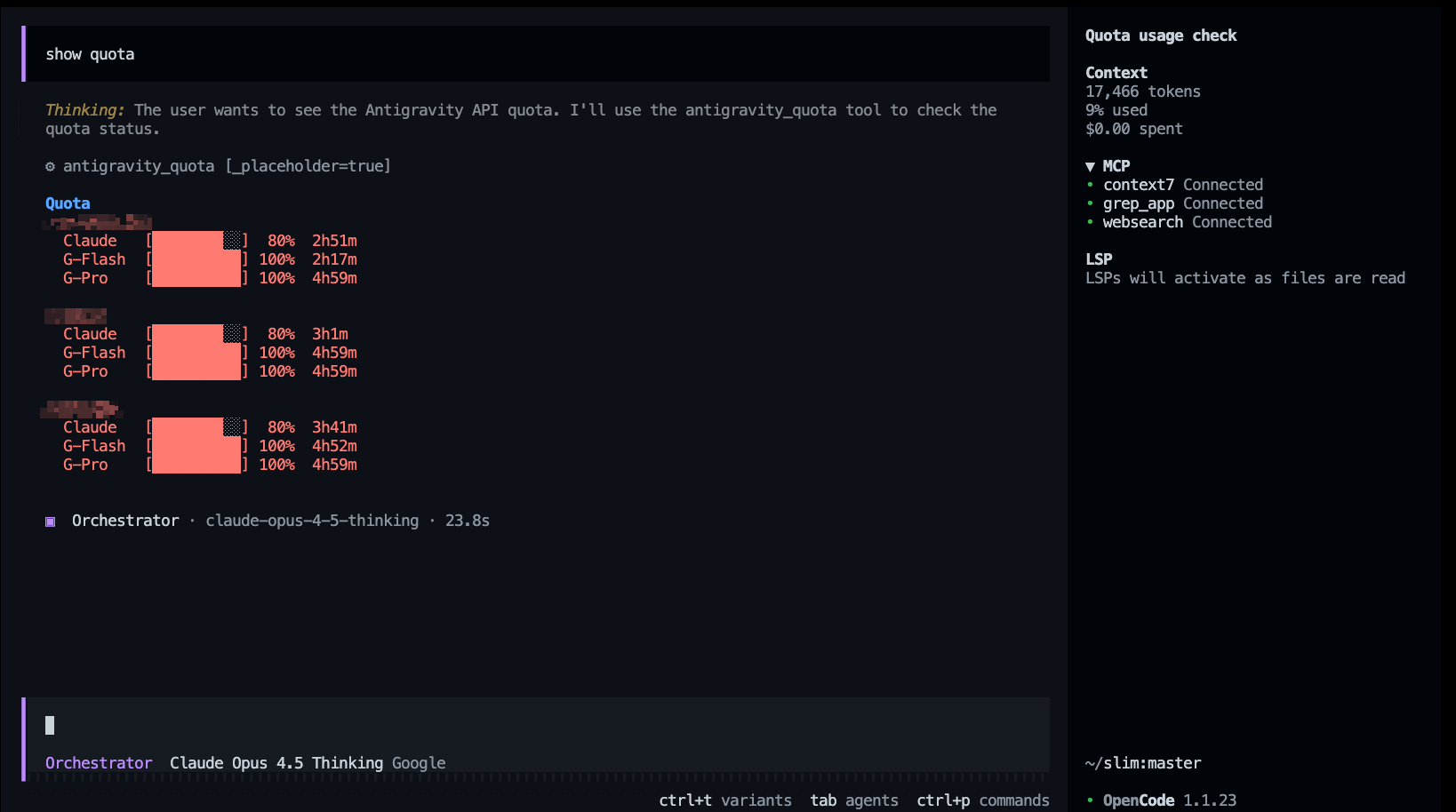 | Tool | Description |
|------|-------------|
| `antigravity_quota` | Check API quota for all Antigravity accounts (compact view with progress bars) |
---
### Background Tasks
The plugin provides tools to manage asynchronous work:
| Tool | Description |
|------|-------------|
| `background_task` | Launch an agent in a new session (`sync=true` blocks, `sync=false` runs in background) |
| `background_output` | Fetch the result of a background task by ID |
| `background_cancel` | Abort running tasks |
---
### LSP Tools
Language Server Protocol integration for code intelligence:
| Tool | Description |
|------|-------------|
| `lsp_goto_definition` | Jump to symbol definition |
| `lsp_find_references` | Find all usages of a symbol across the workspace |
| `lsp_diagnostics` | Get errors/warnings from the language server |
| `lsp_rename` | Rename a symbol across all files |
---
### Code Search Tools
Fast code search and refactoring:
| Tool | Description |
|------|-------------|
| `grep` | Fast content search using ripgrep |
| `ast_grep_search` | AST-aware code pattern matching (25 languages) |
| `ast_grep_replace` | AST-aware code refactoring with dry-run support |
---
## 🧩 Skills
Skills are specialized capabilities that combine MCP servers with specific instructions for the Orchestrator.
### Playwright Integration
**The Orchestrator's eyes and hands in the browser.**
| Tool | Description |
|------|-------------|
| `skill` | Loads a skill (e.g., `playwright`) and provides its instructions and available MCP tools |
| `skill_mcp` | Invokes a specific tool from an MCP server managed by a skill |
#### Key Features
- **Browser Automation**: Full Playwright capabilities (browsing, clicking, typing, scraping).
- **Screenshots**: Capture visual state of any web page.
- **Sandboxed Output**: Screenshots are safely saved to `/tmp/playwright-mcp-output/`.
---
## MCP Servers
Built-in Model Context Protocol servers (enabled by default):
| MCP | Purpose | URL |
|-----|---------|-----|
| `websearch` | Real-time web search via Exa AI | `https://mcp.exa.ai/mcp` |
| `context7` | Official library documentation | `https://mcp.context7.com/mcp` |
| `grep_app` | GitHub code search via grep.app | `https://mcp.grep.app` |
### Disabling MCPs
You can disable specific MCP servers in your config:
```json
{
"disabled_mcps": ["websearch", "grep_app"]
}
```
---
## Configuration
You can customize the behavior of the plugin via JSON configuration files.
### Configuration Files
The plugin looks for configuration in two places (and merges them):
1. **User Global**: `~/.config/opencode/oh-my-opencode-slim.json` (or OS equivalent)
2. **Project Local**: `./.opencode/oh-my-opencode-slim.json`
| Platform | User Config Path |
| :--- | :--- |
| **Windows** | `~/.config/opencode/oh-my-opencode-slim.json` or `%APPDATA%\opencode\oh-my-opencode-slim.json` |
| **macOS/Linux** | `~/.config/opencode/oh-my-opencode-slim.json` |
### Disabling Agents
You can disable specific agents using the `disabled_agents` array:
```json
{
"disabled_agents": ["multimodal-looker", "code-simplicity-reviewer"]
}
```
---
## Uninstallation
1. **Remove the plugin from your OpenCode config**:
Edit `~/.config/opencode/opencode.json` and remove `"oh-my-opencode-slim"` from the `plugin` array.
2. **Remove configuration files (optional)**:
```bash
rm -f ~/.config/opencode/oh-my-opencode-slim.json
rm -f .opencode/oh-my-opencode-slim.json
```
---
## Credits
This is a slimmed-down fork of [oh-my-opencode](https://github.com/code-yeongyu/oh-my-opencode) by [@code-yeongyu](https://github.com/code-yeongyu).
---
## License
MIT
| Tool | Description |
|------|-------------|
| `antigravity_quota` | Check API quota for all Antigravity accounts (compact view with progress bars) |
---
### Background Tasks
The plugin provides tools to manage asynchronous work:
| Tool | Description |
|------|-------------|
| `background_task` | Launch an agent in a new session (`sync=true` blocks, `sync=false` runs in background) |
| `background_output` | Fetch the result of a background task by ID |
| `background_cancel` | Abort running tasks |
---
### LSP Tools
Language Server Protocol integration for code intelligence:
| Tool | Description |
|------|-------------|
| `lsp_goto_definition` | Jump to symbol definition |
| `lsp_find_references` | Find all usages of a symbol across the workspace |
| `lsp_diagnostics` | Get errors/warnings from the language server |
| `lsp_rename` | Rename a symbol across all files |
---
### Code Search Tools
Fast code search and refactoring:
| Tool | Description |
|------|-------------|
| `grep` | Fast content search using ripgrep |
| `ast_grep_search` | AST-aware code pattern matching (25 languages) |
| `ast_grep_replace` | AST-aware code refactoring with dry-run support |
---
## 🧩 Skills
Skills are specialized capabilities that combine MCP servers with specific instructions for the Orchestrator.
### Playwright Integration
**The Orchestrator's eyes and hands in the browser.**
| Tool | Description |
|------|-------------|
| `skill` | Loads a skill (e.g., `playwright`) and provides its instructions and available MCP tools |
| `skill_mcp` | Invokes a specific tool from an MCP server managed by a skill |
#### Key Features
- **Browser Automation**: Full Playwright capabilities (browsing, clicking, typing, scraping).
- **Screenshots**: Capture visual state of any web page.
- **Sandboxed Output**: Screenshots are safely saved to `/tmp/playwright-mcp-output/`.
---
## MCP Servers
Built-in Model Context Protocol servers (enabled by default):
| MCP | Purpose | URL |
|-----|---------|-----|
| `websearch` | Real-time web search via Exa AI | `https://mcp.exa.ai/mcp` |
| `context7` | Official library documentation | `https://mcp.context7.com/mcp` |
| `grep_app` | GitHub code search via grep.app | `https://mcp.grep.app` |
### Disabling MCPs
You can disable specific MCP servers in your config:
```json
{
"disabled_mcps": ["websearch", "grep_app"]
}
```
---
## Configuration
You can customize the behavior of the plugin via JSON configuration files.
### Configuration Files
The plugin looks for configuration in two places (and merges them):
1. **User Global**: `~/.config/opencode/oh-my-opencode-slim.json` (or OS equivalent)
2. **Project Local**: `./.opencode/oh-my-opencode-slim.json`
| Platform | User Config Path |
| :--- | :--- |
| **Windows** | `~/.config/opencode/oh-my-opencode-slim.json` or `%APPDATA%\opencode\oh-my-opencode-slim.json` |
| **macOS/Linux** | `~/.config/opencode/oh-my-opencode-slim.json` |
### Disabling Agents
You can disable specific agents using the `disabled_agents` array:
```json
{
"disabled_agents": ["multimodal-looker", "code-simplicity-reviewer"]
}
```
---
## Uninstallation
1. **Remove the plugin from your OpenCode config**:
Edit `~/.config/opencode/opencode.json` and remove `"oh-my-opencode-slim"` from the `plugin` array.
2. **Remove configuration files (optional)**:
```bash
rm -f ~/.config/opencode/oh-my-opencode-slim.json
rm -f .opencode/oh-my-opencode-slim.json
```
---
## Credits
This is a slimmed-down fork of [oh-my-opencode](https://github.com/code-yeongyu/oh-my-opencode) by [@code-yeongyu](https://github.com/code-yeongyu).
---
## License
MIT