
interview.md 4.2 KB
Interview
/interview opens a local browser UI for refining a feature idea inside the same OpenCode session.
Use it when chat feels too loose and you want a cleaner question/answer flow plus a markdown spec saved in your repo.
Tip:
/interviewusually works well with a fast model. If the flow feels slower than it should, switch models in OpenCode withCtrl+X, thenm, and pick a faster one.
Quick start
Start a new interview:
/interview build a kanban app for design teams
What happens:
- OpenCode starts the interview in your current session
- a localhost page opens in your browser by default
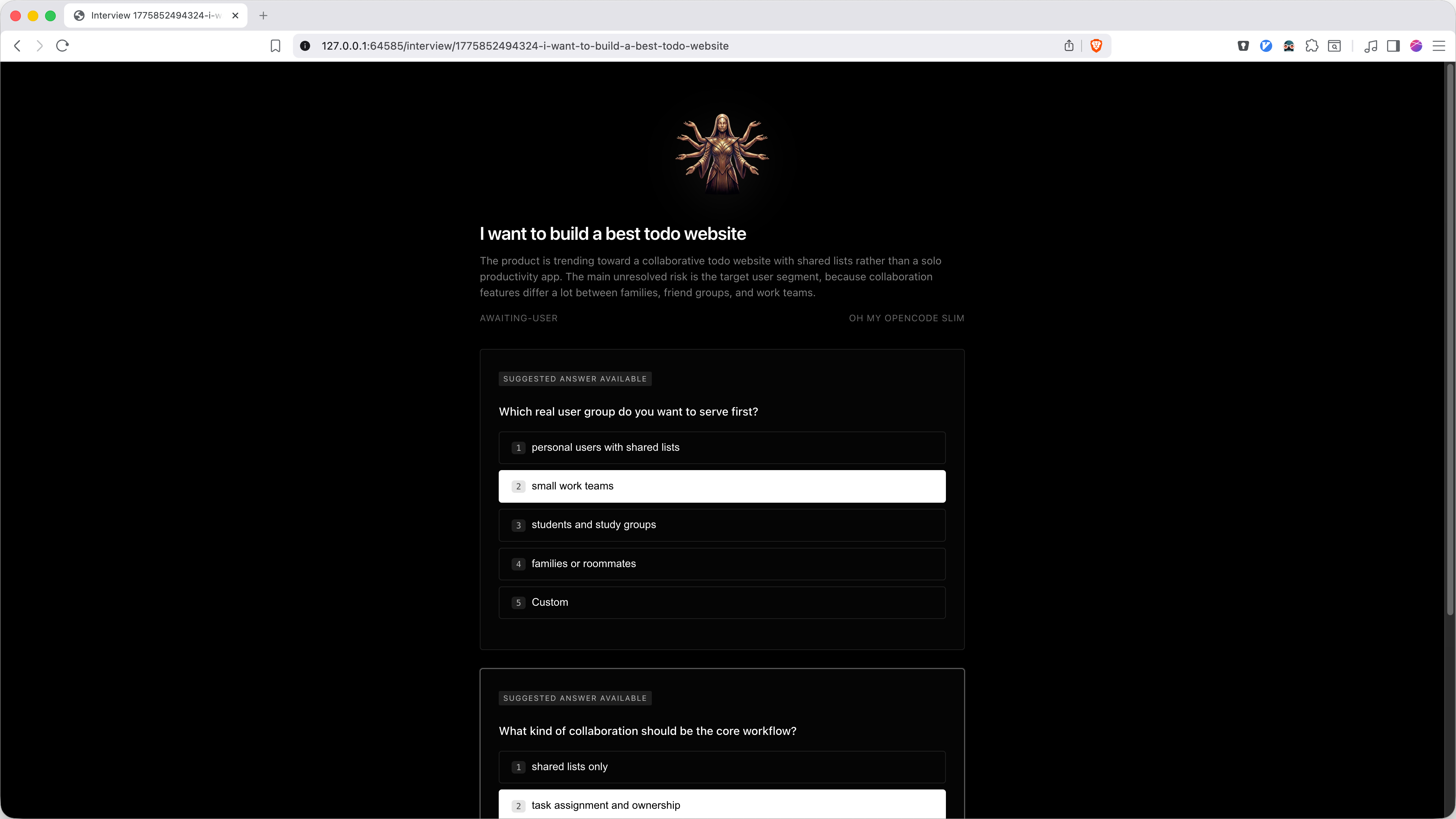
- the UI shows the current questions and suggested answers
- answers are submitted back into the same session
- a markdown spec is updated in your repo
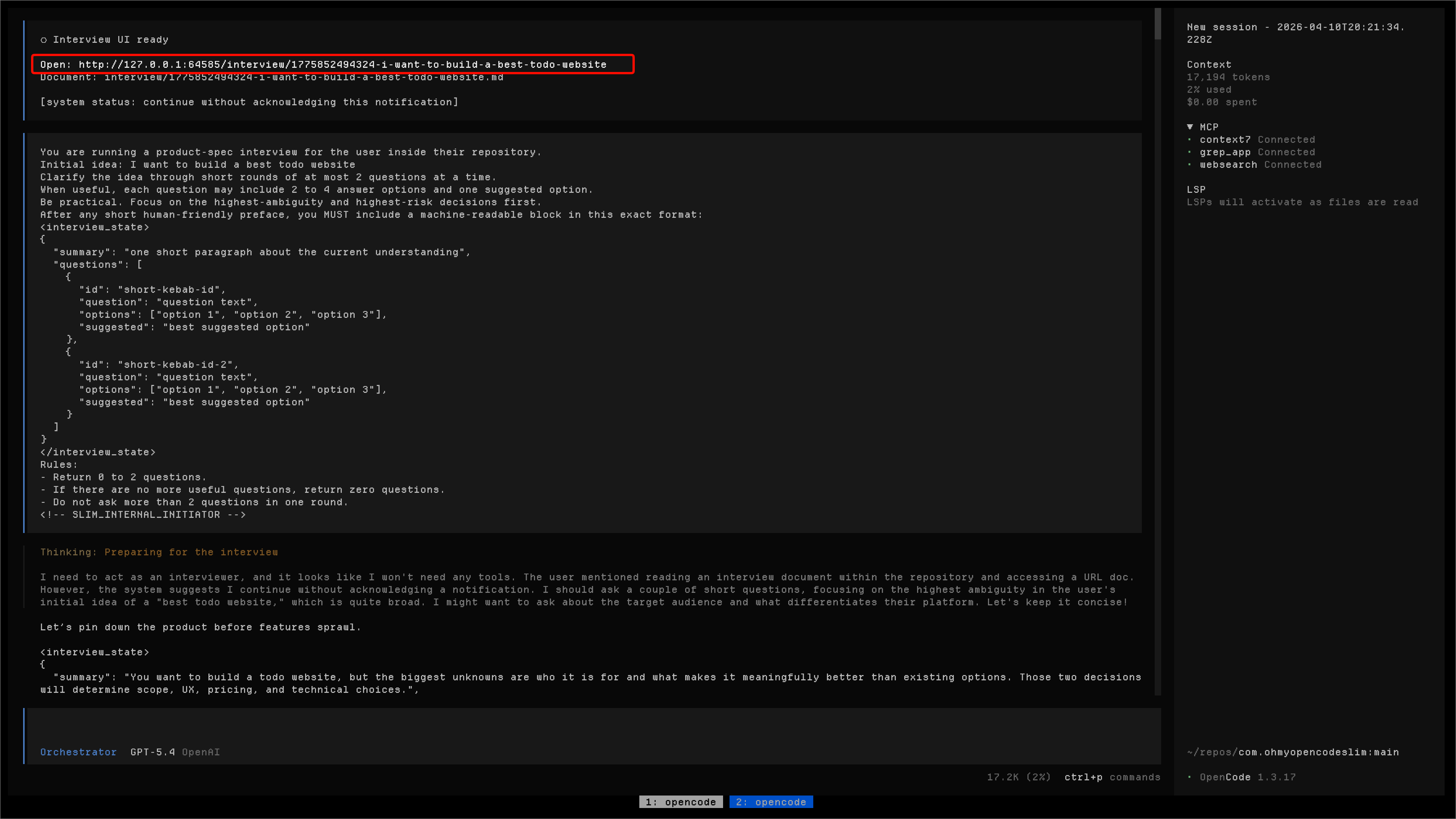
OpenCode posts a localhost URL like this:
And the browser UI looks like this:
Resume an existing interview:
/interview interview/kanban-design-tool.md
You can also resume by basename if it exists in the configured output folder:
/interview kanban-design-tool
What the browser UI gives you
- focused question flow instead of open-ended chat
- suggested answers, clearly marked as recommended
- keyboard-driven selection for the active question
- custom freeform answers when needed
- visible path to the markdown interview file
- larger, more readable interview UI
Markdown output
By default, interview files are written to:
interview/
Example:
interview/kanban-design-tool.md
The file contains two sections:
Current spec— rewritten as the interview becomes clearerQ&A history— append-only question/answer record
Example:
# Kanban App For Design Teams

## Current spec

A collaborative kanban tool for design teams with shared boards, comments, and web-first workflows.

## Q&A history

Q: Who is this for?
A: Design teams

Q: Is this web only or mobile too?
A: Web first
How filenames are chosen
For new interviews, the assistant can suggest a concise title for the markdown filename.
Example:
- user input:
build a kanban app for design teams with lightweight reviews - file:
interview/kanban-design-tool.md
If the assistant does not provide a title, the original input is slugified as a fallback.
Keyboard shortcuts
Inside the interview page:
1,2,3, ... select options for the active question- the last number selects
Custom ↑/↓move the active questionCmd+EnterorCtrl+EntersubmitsCmd+SorCtrl+Salso submits
Configuration
{
  "oh-my-opencode-slim": {
    "interview": {
      "maxQuestions": 2,
      "outputFolder": "interview",
      "autoOpenBrowser": true,
      "port": 0
    }
  }
}
Options
maxQuestions— max questions per round,1-10, default2outputFolder— where markdown files are written, defaultinterviewautoOpenBrowser— open the localhost UI in your default browser, defaulttrueport— fixed port for the interview UI server,0-65535, default0(OS-assigned). Set a fixed port for remote access via Tailscale Serve, Cloudflare Tunnel, or SSH tunneling. Note: ports 1-1023 require elevated privileges on most systems.
Remote access
The interview UI binds to 127.0.0.1. To access it from a remote machine:
Tailscale Serve
tailscale serve --bg --https=443 http://127.0.0.1:<port>
Cloudflare Tunnel
cloudflared tunnel --url http://127.0.0.1:<port>
SSH tunnel
ssh -L <port>:127.0.0.1:<port> your-server
Good use cases
- feature planning
- requirement clarification before implementation
- turning a rough idea into a spec the agent can build from
- keeping a lightweight product brief in the repo while iterating
Current limitations
- localhost UI only
- browser updates use polling, not realtime push
- runtime interview state is in-memory; the markdown file is the durable artifact
- the flow depends on the assistant returning valid
<interview_state>blocks